If you intend to book DZK exit capacity for a final customers, please choose the DZK-type “RLM” during the application for new balancing groups in the THE portal. Please assign the corresponding entry capacity to the same balancing group. For bayernets this is currently only the case for the grid points Schongau and Wacker.
bayernets expects from the supplier of the power plant to send a binding forecast in form of a technical offtake notice (TON) in the format NOMINT. The TON has to be sent to us until 22:00 CEST/CET on the day before delivery and again in case of any changes regarding the offtake of the power plant.
In general, you can supply the power plant via VTP. However, in case of a congestion on the bayernets grid we will inform the supplier of the power plant 4 hours in advance and the supply via VTP will no longer be possible. Subsequently, a supply of the power plant using the predefined entry corresponding to the TON becomes mandatory (please check Appendix 1 of the agreement on the cooperation between operators of gas supply networks in Germany section 9 and section 29b).
In case the entry is not sufficient for the power plant (entry < TON), bayernets can interrupt the remaining interruptible part of the DZK-capacity. If the interrupted part of the DZK-capacity is still used by the power plant, we will regard this as a capacity exceedance. Furthermore, we might assert any claims for damages.
You can find the possible DZK connections here: DZK capacity allocation restrictions
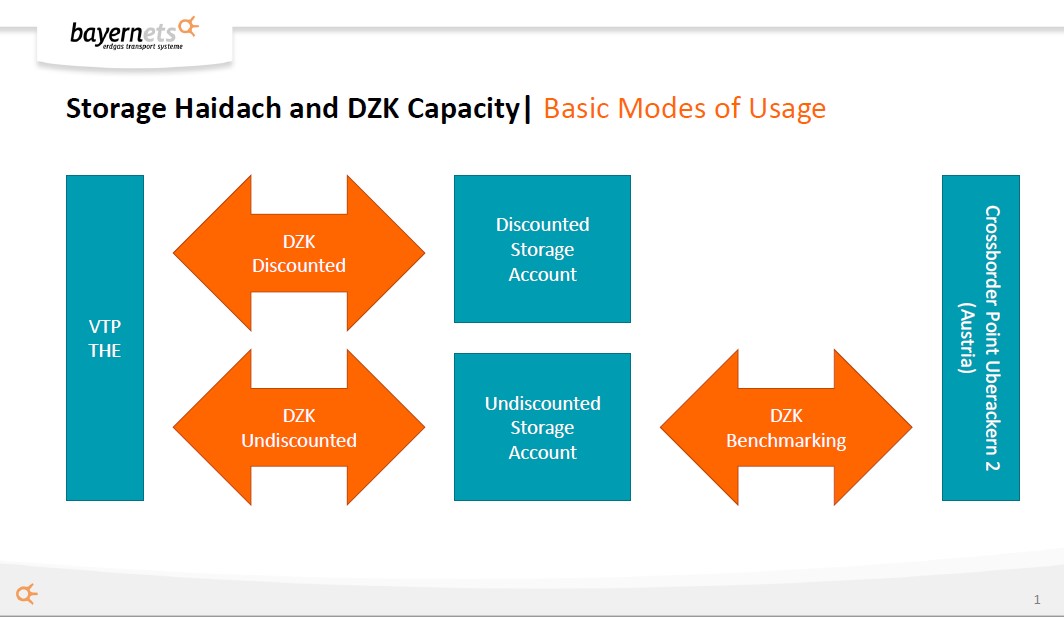
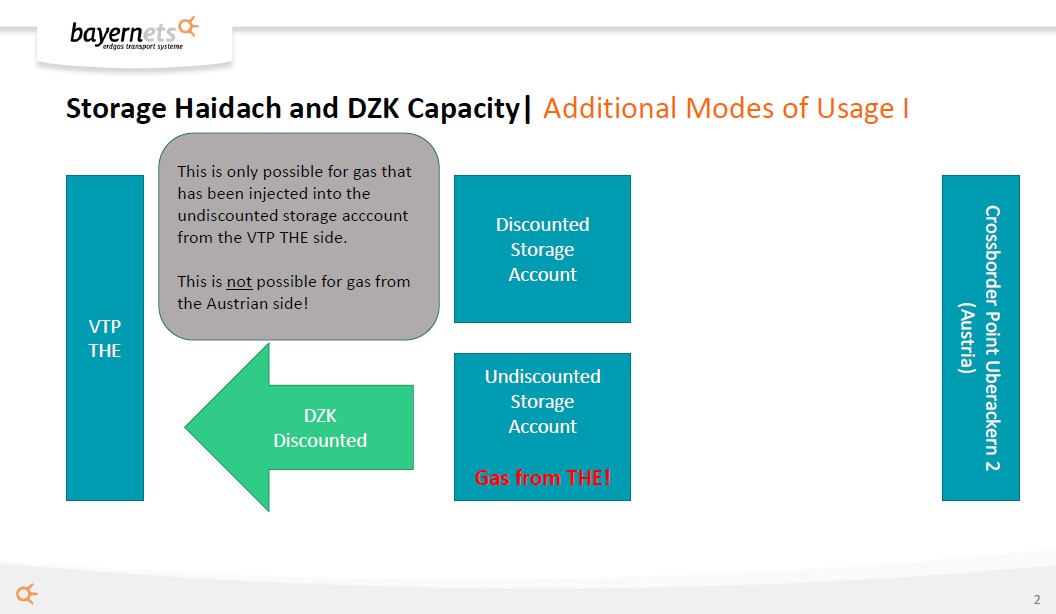
Transfer of gas between discounted to undiscounted storage accounts according to REGENT 2021
The normal way to initiate such a transaction would be to book capacity back into the market area, plus another capacity back into the storage. Instead of these two bookings, you can also directly transfer the gas within the storage. The total costs consist of the costs for a discounted booking, e.g. for injection (25%) plus the costs for an undiscounted booking, e.g. for withdrawal (100%). In total, the overall costs amount to 125% of the standard capacity at the grid point. For periods from 01st December 2025 onwards, we will offer a 10% discount on these bookings in accordance with the current regulation.
How does it work?
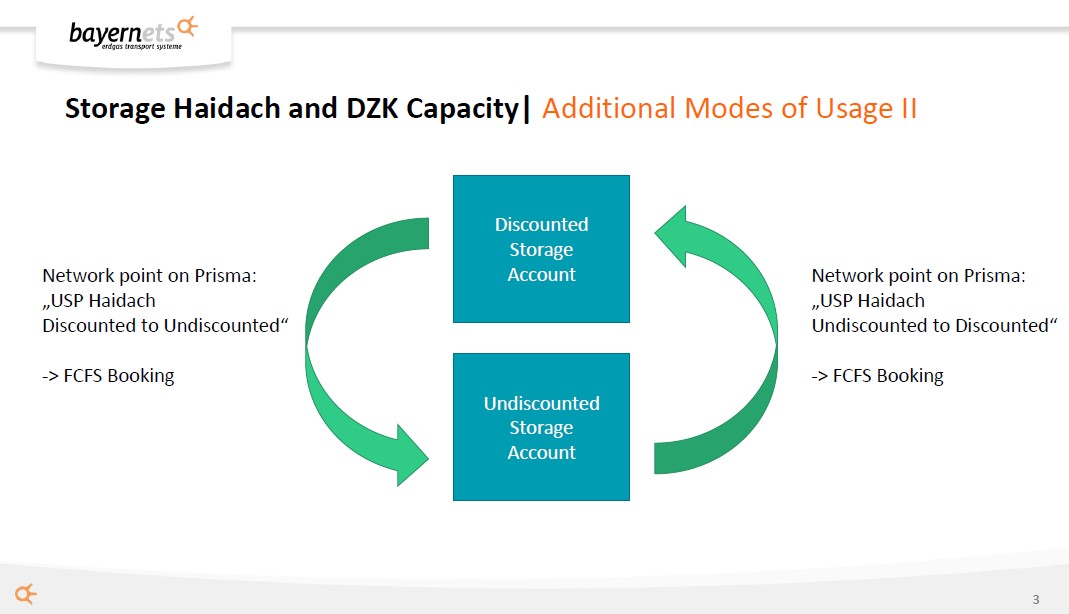
On PRISMA, select the correct capacity at the storage point labeled "Discounted to Undiscounted" or "Undiscounted to Discounted". After booking the capacity, a notification will be sent from PRISMA to bayernets and the storage operator, and the charges will be calculated as described above.
Please note the hourly basis of the booking: for example, if you want to transfer 24.000 kWh, you must book 1.000 kWh/h.
The following graphic shows an example of these options for USP Haidach.
All firm capacity products at a specific network point (including DZK) have to be sold-out before in order to activate bookings via overnomination.
Here you get an overview of the current status of each network point regarding over-nomination.
bayernets has a portal that is available for transport customers and offers them – amongst other options – the possibility to change assignments of capacities to balancing groups. In general active transport customers already have the necessary login information. In case you have no login information yet, please contact bayernets (market@bayernets.de).
Overbooking/overrun is not possible at our grid.
Yes.
DZK is considered as firm capacity when the point(s)-to-point(s) criteria of the specific DZK product are met and only a specific transmission path it used. E.g. a DZK exit becomes a firm product when specific entry points are nominated within the same balancing group. In this case, the capacity type of the entry product does not matter – only the resulting entry nominations make the DZK exit product a firm capacity.
However, if the DZK exit nominations exceed the corresponding entry nominations, the exceeding part becomes interruptible.
The same applies vice versa for DZK entry products.
Types of use for Regular Balancing group:
An "F" in the sixth position and any number except for 9 in the eighth position (THE0BFH)
Exit regular end users
Discounted Exit and Entry to storage facilities
Entry and Exit Transports at Cross-border points
Types of use for non-discounted storage balancing groups:
An "F" in the sixth position and a 9 in the eighth position (THE0BFH9)
Exit regular end users
Undiscounted Entry and Exit to storage facilities
Entry and Exit Transports at Cross-border points
DZK type:
RLM: Used for DZK Power plants and therefore DZK power plant balancing group is mandatory.
From 01.01.2025 onwards, the storage levy will only apply to RLM and SLP points. No longer to IPs. Storage transports (including cross-border storage transport) were exempted from the storage levy.